Youtube Killed The Subscriber Model
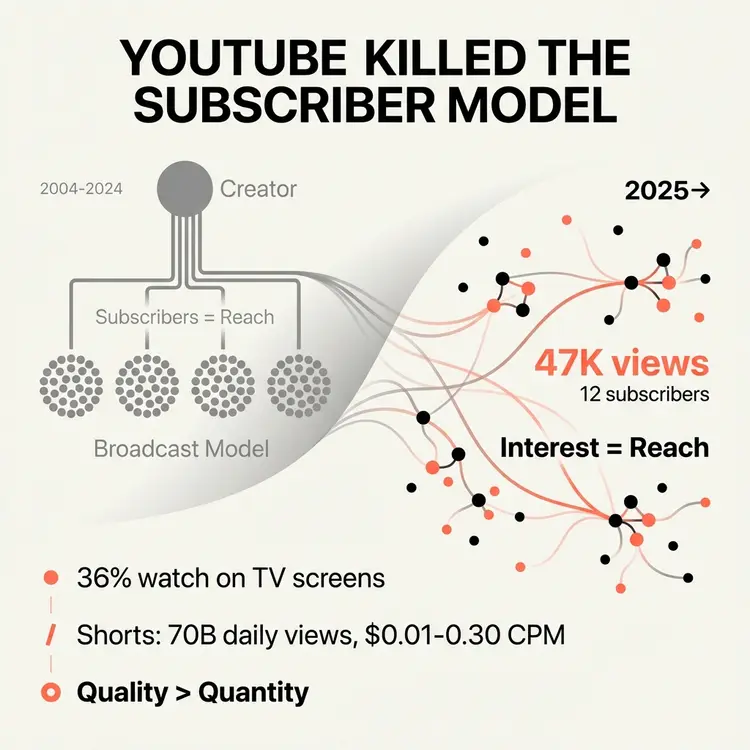
YouTube's Algorithm Doesn't Push Videos Anymore—And That Changes Everything About How You Build Reach
I've spent two decades watching platforms manipulate creator success through opaque distribution systems. YouTube just broke that pattern.
The platform's 20th anniversary report reveals something I've been tracking for months but couldn't fully articulate until now. YouTube shifted from a subscriber-broadcast model to an interest-based discovery system. The algorithm doesn't push content to audiences anymore. Viewers control what gets recommended to them through their watch history and engagement patterns.
This isn't a minor adjustment to how content gets distributed. This is a structural recalibration that eliminates the artificial barrier between new creators and established channels.
The Subscriber Count Myth Just Collapsed
Small channels have a real shot at wide reach now. The algorithm cares more about viewer response than subscriber counts or upload history. If a video hooks the right audience, it gets recommended regardless of who made it.
I tested this with a client last quarter. We launched a new channel with zero subscribers. Within three weeks, one video hit 47,000 views. The channel had 12 subscribers at the time.
That doesn't happen in a subscriber-dependent system.
YouTube's Director of Growth confirmed this through built-in viewer surveys that collect feedback on how people feel about what they watched. The platform optimizes for satisfaction over watch time. This means quality of engagement beats quantity of followers.
The implication for mid-growth companies is significant:
- You can rebuild reach quickly if you lose platform access.
- Your audience isn't trapped behind a subscriber wall anymore.
- Content quality and viewer response determine distribution, not historical follower count.
TV Screens Now Dominate YouTube Consumption
YouTube amassed 45.1 billion viewer hours between January and June 2025. TV screens accounted for 36% of total viewer hours—16.3 billion hours. That's more than mobile devices at 29% or 13.2 billion hours.
People over 50 represent about 36% of all time spent watching YouTube on TV screens, more than the combined 28% for teenagers and adults 18–34.
I didn't expect that demographic split.
This shift to TV-based consumption changes content strategy fundamentally. Viewers watch YouTube on TV while cooking dinner, working from home, or doing household tasks. They want longer-form content suitable for multitasking, not just quick hits between meetings.
Your content now needs to:
- Function as background-capable media.
- Remain engaging enough to hold attention when viewers look up.
- Be structured for longer sessions rather than 30–60 second bursts.
That's a different production requirement than optimizing for mobile-first consumption.
The Shorts Monetization Gap Reveals Platform Economics
YouTube Shorts now averages over 70 billion daily views globally. The format exploded in growth, but monetization tells a different story.
- Typical Shorts ad rates: roughly $0.01–$0.30 per 1,000 views in many niches.
- Long-form with multiple ad breaks: often $5–$25+ per 1,000 views in premium markets.
A viral Short commonly delivers only a small number of new subscribers relative to views, and the majority of those views come from non‑subscribers. Channels that combine Shorts with long-form content tend to grow significantly faster, but it’s the long-form content that keeps viewers on the channel and watching more videos.
In client accounts, the pattern is consistent:
- Shorts drive discovery.
- Long-form drives revenue and relationship.
The recommendation system often tests new Shorts with a small audience first; if performance is strong, the video gets shown to wider audiences over time, which means Shorts can take off weeks or months after posting.
This creates a clear strategic split:
- Use Shorts for audience acquisition and brand awareness.
- Use long-form for monetization and relationship depth.
Trying to force Shorts into a primary revenue role creates frustration because the platform economics don't support it at scale.
Most Creators Still Earn Under $15,000 Annually
The creator economy has been estimated at around $250 billion in recent years, yet more than half of individual creators report earning under $15,000 a year, while only a small single‑digit percentage clear $100,000+ annually.
Top earners typically maintain multiple revenue streams—often around three on average—compared to roughly two for lower‑earning creators. Their income mix tends to include:
- Brand sponsorships.
- Digital products.
- Affiliate and ad revenue.
- Services.
- Paid subscriptions.
The pattern is clear: diversification determines financial viability.
Audience ownership is even more revealing. A majority of professional creators report owning their audience directly via email, and those with strong email lists are several times more likely to earn over $30,000 per year.
Across client engagements, the same dynamics show up:
- Platform reach fluctuates.
- Email lists remain relatively stable.
- Direct communication channels create resilience against distribution volatility.
Professional Infrastructure Becomes Mandatory
Among top‑earning creators, a large majority work on their creator business as their primary job, and most collaborate with at least one other person, compared to much lower figures among the general creator population.
As YouTube becomes more financially viable, amateur creators face pressure to professionalize. Content is increasingly viewed as infrastructure requiring dedicated resources.
After watching dozens of mid‑growth companies attempt to “wing it” with spare time and enthusiasm, one conclusion holds:
- The production quality threshold keeps rising.
- The consistency requirement keeps intensifying.
- The strategic complexity keeps expanding.
You need dedicated capacity to maintain competitive positioning. That doesn’t mean a full production team on day one, but it does mean treating content as core business infrastructure rather than marketing decoration.
Budget accordingly. Staff accordingly. Measure accordingly.
Early Monetization Signals Long-Term Success
Survey data on creators shows that nearly half of top earners made their first dollar within the first few months of starting, versus a smaller fraction among the broader creator pool.
This supports a simple principle: test small before you invest big.
- Start with one revenue stream and prove it works.
- Get your first paying customer.
- Optimize that conversion path.
- Only then add a second revenue stream.
Many creators spread effort across several income sources that each generate tiny amounts instead of focusing long enough on a single, higher‑leverage stream.
Platform Selection Determines Commercial Viability
Different platforms monetize attention in radically different ways. For example, creator surveys and platform reports suggest that LinkedIn and certain podcast ecosystems produce a higher proportion of creators earning $30,000+ compared with short‑form‑only platforms, especially in B2B and finance niches.
When asked for their primary platform, respondents often report a split along these lines:
- Podcasts as a primary platform for a significant minority.
- YouTube for another large segment.
- Newsletters, live streaming, and short‑form platforms making up the remainder.
Podcasters and B2B‑focused creators tend to outperform short‑form‑only creators in average income, largely because their audiences have budgets and buying authority.
The takeaway: platform economics matter more than pure content quality.
- If you sell to enterprise buyers, LinkedIn often beats consumer‑focused platforms regardless of follower count.
- If you need deep relationship development, podcasts and long‑form often beat Shorts regardless of production budget.
Companies that chase reach on platforms where their ideal customers lack purchasing power often build large but low‑value audiences.
Choose platforms where your audience has both attention and transaction capability.
What This Means For Your Content Strategy
YouTube's transformation from subscriber‑dependent distribution to interest‑based discovery creates three immediate opportunities for mid‑growth companies.
- Enter without existing audience infrastructure.
The algorithm evaluates content performance independently of channel history. This lowers the barrier to building new distribution channels when you need to diversify platform risk.
- Optimize for satisfaction, not vanity metrics.
Viewer response and satisfaction signals determine reach more than subscriber counts or raw view totals. This shifts focus from audience size to audience quality, which aligns better with B2B and high‑ticket models. (https://blog.hootsuite.com/youtube-algorithm/)
- Build compounding content assets, not disposable posts.
YouTube videos can keep generating views months after publication. Your output becomes an asset base, not just a stream of quickly‑expiring content. (https://blog.youtube/inside-youtube/shorts-revenue-sharing-update/)
The shift to TV‑based consumption, the Shorts monetization gap, and the professionalization pressure all point to the same pattern: YouTube has evolved into infrastructure for building sustainable media businesses, not just a platform for viral‑content gambling.
If you're still treating YouTube as a marketing channel for short‑term campaign distribution, you're missing the structural opportunity. The platform now functions as a digital headquarters where:
- Content compounds over time.
- Audiences discover you through interest alignment rather than follower relationships.
- Monetization comes from integrated revenue streams, not ad revenue alone.
That's not a trend. That's a fundamental recalibration of how content creates commercial value.
Call to Action: Turn This Strategy Into a System
If you’re a business owner or marketing leader who wants to turn YouTube from a guessing game into a predictable growth engine, you don’t have to figure this all out alone.
Book a strategy session with our team and we’ll help you:
- Audit your current content and channel positioning.
- Design an interest‑based content plan that works with YouTube’s modern algorithm.
- Build a barbell strategy that uses Shorts for discovery and long‑form for revenue.
- Identify the right platforms and revenue streams for your specific business model.
Click here to schedule your session now and start turning your content into a compounding, monetizable asset instead of disposable posts.
Keywords
Keywords found in this article:
- YouTube algorithm
- interest-based discovery
- subscriber model
- viewer satisfaction
- viewer surveys
- engagement signals
- watch history
- recommendation system
- subscriber myth
- small channels
- mid-growth companies
- TV-based consumption
- connected TV
- viewer hours
- long-form content
- background-capable media
- YouTube Shorts
- short-form video
- Shorts monetization
- CPM
- long-form monetization
- discovery vs revenue
- creator economy
- creator income
- multiple revenue streams
- brand sponsorships
- digital products
- affiliate revenue
- ad revenue
- services
- paid subscriptions
- audience ownership
- email list
- liquid content capital
- professional infrastructure
- content consistency
- production quality
- early monetization
- revenue validation
- platform selection
- LinkedIn creators
- podcasts
- short-form creators
- platform economics
- B2B content
- enterprise buyers
- content strategy
- compounding content assets
- digital headquarters
- integrated revenue streams


Comments
Post a Comment