I've watched this happen for years now. Someone builds a content engine—blog posts, videos, social media, podcasts—and then wonders why leads aren't converting. They're producing constantly, publishing religiously, and still struggling to close deals. The problem isn't effort. The problem is they've confused one ingredient with the entire meal.
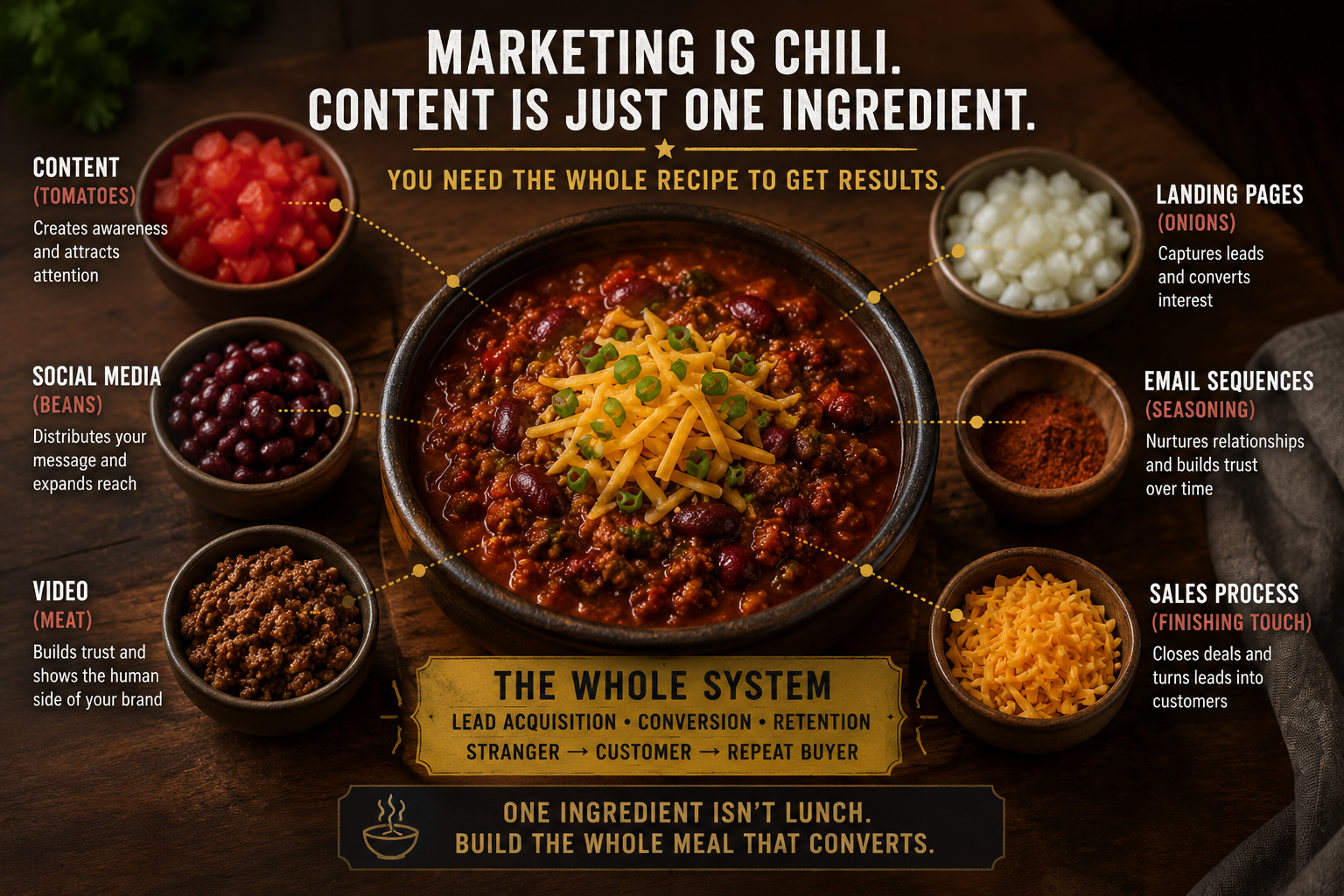
Marketing is the full process. Lead acquisition, conversion, retention. The whole system that moves someone from stranger to customer to repeat buyer. Content is just one piece of that. Important? Absolutely. But calling content "marketing" is like calling tomatoes "chili."
You need more than tomatoes to make chili.
The Digital Chili Problem
Think about making chili. You've got tomatoes, beans, meat, onions, seasoning. Each ingredient matters. But you don't just throw raw tomatoes in a bowl and call it lunch. You combine everything, stir it in a pot, let it simmer, add bourbon for smokiness, honey for creaminess, maybe some milk and yogurt for texture. The process transforms individual ingredients into something people actually want to eat.
Marketing works the same way. Content is your tomato. Social media is your beans. Video is your meat. Landing pages, email sequences, follow-up systems—those are your onions and seasoning. You need all of it, cooked together, to create something that converts.
I've seen companies invest heavily in content creation and then wonder why their sales pipeline stays empty. They're publishing three blog posts a week, posting daily on LinkedIn, recording podcast episodes. But there's no landing page to capture leads. No email sequence to nurture interest. No sales process to close the deal. They're serving raw ingredients and expecting people to be satisfied.
Why This Misconception Persists
The content-as-marketing myth gained traction because content became easier to produce. Desktop publishing disrupted print in the 1980s. Social media platforms democratized distribution in the 2000s. Video production tools became accessible in the 2010s. Suddenly, everyone could create content. And because creation became the visible part of marketing, people started treating it as the whole thing.
But creation was never the hard part. Distribution, conversion, retention—those are the challenges that separate successful campaigns from noise.
I've managed over a billion dollars in portfolio across my career, produced 850 websites, brought 7,000 items to market. The pattern I've observed is consistent: companies that treat content as their entire marketing strategy plateau quickly. They build an audience but can't convert it. They generate awareness but can't capture leads. They create engagement but can't close sales.
The missing pieces aren't more content. They're the systems that turn attention into action.
The Components That Actually Convert
Marketing requires orchestration. You need content that attracts attention. Social channels that distribute it. Landing pages that capture interest. Email sequences that build trust. Sales processes that close deals. Retention systems that create repeat buyers. Each component serves a specific function in the conversion process.
When I work with clients—founders and CEOs of $3-5M companies in construction, manufacturing, mental health, law enforcement—they often arrive burned by agencies that promised results through content alone. They've been told to "just post more" or "build your personal brand" or "create valuable content." And they did. For months. Sometimes years. With minimal return.
The diagnosis is usually the same: they built one part of the system and ignored the rest.
Content without distribution is invisible. You can write the best blog post in your industry, but if no one sees it, it doesn't matter. Distribution requires social strategy, SEO, paid promotion, partnerships. You need channels that move your content in front of the right people.
Distribution without capture is wasted. You can drive thousands of visitors to your website, but if there's no way to capture their information, they disappear. Capture requires landing pages, lead magnets, forms, calls-to-action. You need mechanisms that convert attention into contact.
Capture without nurture is abandoned. You can collect email addresses, but if you don't follow up, people forget about you. Nurture requires email sequences, retargeting campaigns, value delivery. You need systems that build trust over time.
Nurture without sales process is incomplete. You can build relationships, but if you never ask for the sale, revenue doesn't happen. Sales requires proposals, presentations, negotiations, closing mechanisms. You need processes that convert interest into transactions.
Each component depends on the others. Remove one, and the entire system weakens.
The Lunch Analogy
Marketing is lunch. Content is just one item on the menu.
You don't walk into a restaurant and order "food." You order a specific meal—burger, salad, pasta, whatever. That meal is made from multiple ingredients, prepared in a specific way, served at the right temperature. The chef doesn't just hand you raw chicken and call it dinner. They cook it, season it, plate it, present it.
Your marketing needs the same treatment. You're not serving raw content and hoping people convert. You're building a complete system that guides someone from awareness to purchase to loyalty. Each touchpoint serves a purpose. Each channel plays a role. Each piece of content fits into a larger strategy.
I've built sales enablement systems for over 70 law enforcement agencies. The work doesn't stop at creating content. It includes on-camera presentation coaching, confidence-building, imposter syndrome dismantling, brand equity protection. Because content alone doesn't close deals. People close deals. And people need more than blog posts to succeed.
What Actually Works
The companies that win don't separate content from strategy. They integrate everything into a unified system where each component reinforces the others.
They create content that addresses specific pain points at specific stages of the buyer journey. Awareness-stage content answers broad questions. Consideration-stage content compares solutions. Decision-stage content removes objections. Each piece serves a strategic purpose beyond "posting something."
They distribute that content through channels where their audience actually spends time. Not every platform. Not every format. Just the ones that matter for their specific market. They focus distribution energy where it generates the highest return.
They capture attention through landing pages designed for single actions. Not homepage redirects. Not generic contact forms. Specific pages that offer specific value in exchange for specific information. The capture mechanism matches the content promise.
They nurture leads through sequences that deliver value before asking for anything. Not immediate sales pitches. Not aggressive follow-ups. Helpful information that builds trust and demonstrates expertise. The nurture process earns the right to sell.
They close deals through sales processes that align with how their customers actually buy. Not pushy tactics. Not manipulative scripts. Clear presentations of value, honest conversations about fit, straightforward proposals. The sales approach matches the relationship built through earlier stages.
This is marketing. The full system. Content is just one ingredient.
The Infrastructure Question
I'm building something right now that addresses this exact problem—a walk-in video production studio model with broadcast-level infrastructure. Five cameras, 20 audio channels, 500 meg bandwidth, network-quality live editing. The goal is to democratize professional video the way desktop publishing disrupted print.
But the studio isn't just about creating content. It's about creating content that fits into complete marketing systems. Businesses walk in, record their message, and walk out with broadcast-quality video that integrates into landing pages, email sequences, social campaigns, sales presentations. The content serves the system. The system drives results.
That's the difference between content and marketing. Content is output. Marketing is outcome.
Stop Eating Raw Tomatoes
Nobody eats a bowl of raw tomatoes and calls it chili. Nobody should create content in isolation and call it marketing.
You need the full recipe. The complete system. The integrated approach that turns individual components into something people actually want—and are willing to pay for.
Content matters. But it's not the umbrella. It's not the strategy. It's not the solution.
It's one ingredient in a much larger meal.
And if you want people to eat—if you want to close sales, generate revenue, build a sustainable business—you need to cook the whole thing.
Not just serve tomatoes and hope for the best. https://www.leadbuildermarketing.com/the-digital-chili-problem/


Comments
Post a Comment