The Video Format You're Missing Is Costing You Revenue
I've watched companies spend $50,000 on a brand film that gets 200 views while their $500 customer testimonial closes deals for six months straight.
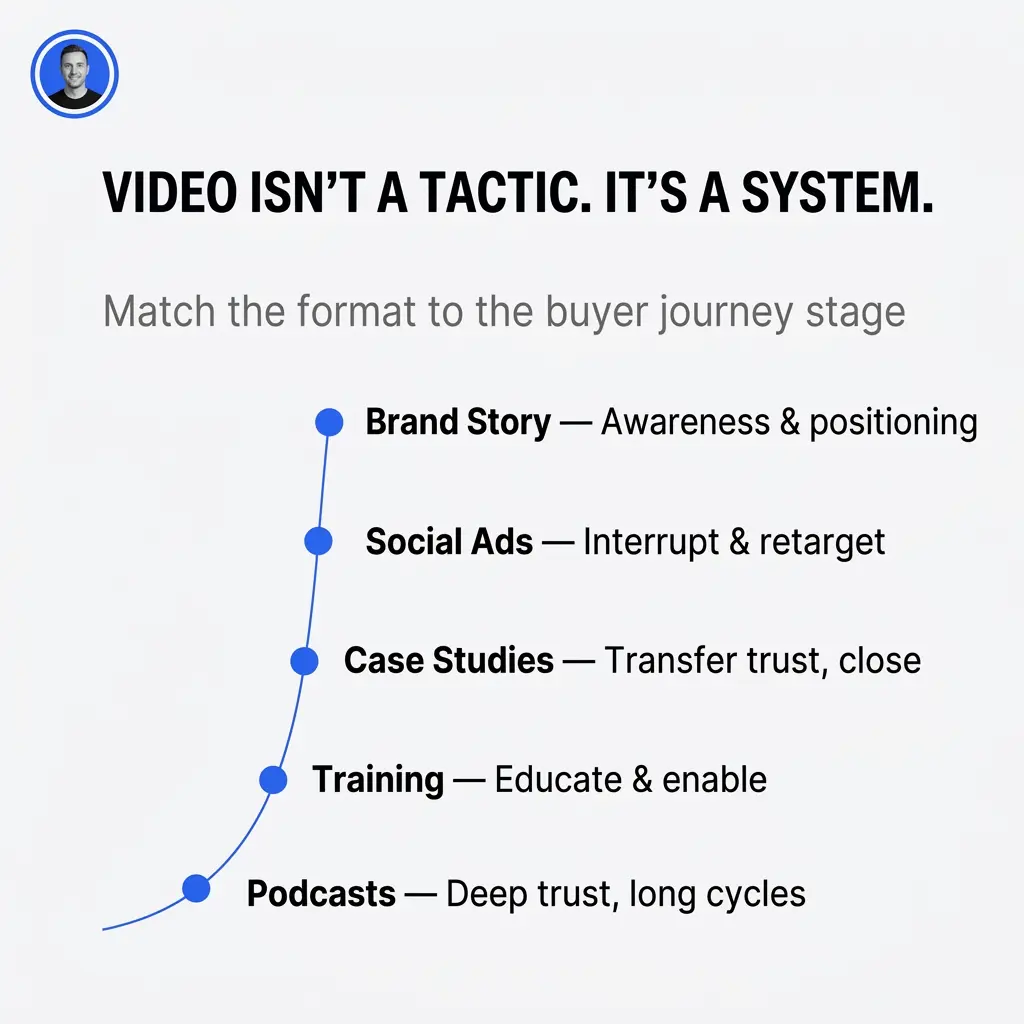
The problem isn't the quality of the video. The problem is that most companies treat video like a single tool when it's actually an entire toolkit—and each format serves a completely different function in your buyer's journey.
You can't use a hammer to tighten a bolt. You can't use a case study video to build brand awareness. And you can't use a social ad to close a deal that needs proof.
After producing 850 websites and managing over a billion dollars in portfolio across 64 years, I've seen the same pattern repeat: companies invest in the wrong video format for the problem they're trying to solve, then wonder why the ROI never materializes.
Here's what I've learned about which formats actually drive outcomes—and how to prioritize based on where your pipeline is broken.
The Buyer Journey Isn't Linear, But Your Video Strategy Should Map to It
Half of all B2B buyers turn to video when they're actively evaluating whether to buy. Not browsing. Not researching casually. Actively deciding.
That means the video you show them at that moment determines whether they move forward or ghost you.
But most companies are showing the wrong format at the wrong time. They're running brand story videos to people who need product walkthroughs. They're using explainer videos when the buyer needs social proof. They're deploying ads when the prospect is already on their pricing page looking for validation.
The buyer journey has stages. Your video strategy needs to match them.
- Awareness stage: They don't know you exist yet. You need reach, frequency, and pattern interruption.
- Consideration stage: They're comparing you to competitors. You need differentiation, education, and credibility.
- Decision stage: They're deciding whether to pull the trigger. You need proof, specificity, and confidence-building.
- Each stage requires a different video format. Deploy the wrong one and you're burning budget on content that can't convert.
Brand Story Videos: The Long Game You Can't Skip
Brand storytelling isn't fluff. People are 22 times more likely to remember a story-based fact than a statistic, and storytelling in marketing has increased conversion rates by as much as 30%.
But here's the thing—brand story videos don't close deals. They build the foundation that makes everything else work.
When someone sees your brand story, they're not ready to buy. They're deciding whether you're worth paying attention to. They're asking: Do I trust these people? Do they understand my world? Do they operate with the kind of certainty I want access to?
A good brand story video answers those questions without ever mentioning your product.
I use brand story videos at the top of the funnel—LinkedIn, YouTube, organic social. The goal isn't immediate conversion. The goal is to create a "things are going to be better" atmosphere that makes people want to stay in your orbit.
You deploy brand story when you need awareness and positioning. You deploy it when you're entering a new market, launching a new service line, or repositioning against competitors who've commoditized your category.
But if your pipeline problem is at the bottom of the funnel—if people are getting to your pricing page and bouncing—brand story won't fix it. You need proof, not positioning.
Social Ads: The Interruption That Has to Earn Attention in Three Seconds
Short-form video delivers the highest ROI among video formats at 41%, and video ads generate 2.4x higher conversion rates than static image ads across all major platforms.
But social ads are not educational content. They're pattern interrupts.
You have three seconds to stop the scroll. If you open with your logo and a slow zoom, you've already lost. If you start with "Hi, I'm the founder of XYZ company," you're done.
Social ads work when they lead with the problem, not the solution. When they speak to the specific pain your audience is experiencing right now, in language they're already using in their heads.
I use social ads for two things: audience building and retargeting.
Audience building: You're reaching cold traffic who've never heard of you. The goal is to get them into your ecosystem—to your website, your email list, your content library. You're not closing deals here. You're earning the right to continue the conversation.
Retargeting: They visited your site but didn't convert. They watched 75% of a video but didn't click. They downloaded a resource but haven't taken the next step. Social ads remind them you exist and give them a reason to come back.
The mistake I see most often is companies trying to educate in a 15-second ad. You can't. You can only provoke curiosity or validate a problem. If your pipeline is weak at the top—if you're not getting enough qualified leads into the funnel—social ads are your lever.
But if your problem is conversion, not traffic, social ads won't solve it.
Case Studies and Testimonials: The Format That Actually Closes Deals
This is where the money is.
Websites featuring video testimonials experience an average conversion rate increase of 80%. Landing pages with embedded video see up to 86% higher conversion rates than those without. And 64% of consumers become more likely to purchase after watching a testimonial video.
Testimonial videos and case studies deliver the strongest ROI because they do what no other format can: they transfer trust from someone who's already bought to someone who's still deciding.
When a prospect hears your customer describe the exact problem they're experiencing, then explain how you solved it, the sale is 70% done. You're no longer selling. The customer is selling for you.
But most companies screw this up by making testimonials about themselves.
A good testimonial video isn't "We love working with this company." It's "Here's the problem we had, here's what we tried that didn't work, here's what changed when we brought them in, and here's the specific outcome we got."
Specificity is the weapon. Not "They helped us grow." But "We went from $3.2 million to $4.8 million in 14 months, and the biggest shift was how they restructured our sales enablement process."
I deploy case studies and testimonials at the decision stage—on landing pages, in sales follow-up emails, embedded in proposals. If your pipeline is leaking at the bottom—if people are engaging but not converting—this is the format that plugs the hole.
One construction tech company integrated video case studies into their CRM and tracked engagement throughout the buyer journey. Result: $6 million in revenue from a single video campaign.
That's not creative. That's infrastructure.
Training Libraries and Thought Leadership: The Compound Interest Play
93% of video marketers say video has helped increase user understanding of their product or service. But training videos and thought leadership content don't just educate—they position you as the authority who doesn't need to sell because people come pre-convinced.
I've built training libraries for clients in manufacturing, multifamily housing, and law enforcement. The format is simple: short, focused videos that answer one specific question each. No fluff. No long intros. Just the answer.
You use training libraries in two ways:
Customer onboarding: Reduce support load, increase product adoption, and create a better post-sale experience. When customers can self-serve answers, they stay longer and refer more.
Sales enablement: Prospects who consume educational content before a sales call show up better informed and closer to a decision. You're not starting from zero. You're starting from "I watched your video on X, and I have a follow-up question."
The ROI on training libraries is slow but compounding. You build it once, and it works for you 24/7. Every video becomes a persistent sales asset that educates, qualifies, and moves buyers forward without requiring your direct involvement.
If your pipeline problem is that prospects don't understand your offering—or if your sales team is spending too much time on basic education—training libraries solve it.
But if your problem is awareness, training content won't help. People have to know you exist before they'll consume your educational content.
Podcast Series: The Depth Play That Builds Uncommon Trust
Podcasts don't convert fast. But they convert deep.
When someone listens to you for 30 minutes, they're not skimming. They're absorbing your thinking, your process, your worldview. By the time they reach out, they don't need to be sold. They're already bought in.
I've seen this with my own clients—founders and CEOs who've listened to me break down sales psychology, brand strategy, and creative systems over multiple conversations. When they hire me, there's no pitch. There's just "I've been listening for six months. I'm ready."
Podcasts work best when you're targeting a small, high-value audience. If you're selling to 10,000 small businesses, a podcast might not be efficient. But if you're selling to 200 decision-makers in a specific vertical, a podcast becomes the most powerful relationship-building tool you have.
You use podcasts when your sales cycle is long, your deal size is large, and your competitive advantage is expertise that can't be easily replicated.
But podcasts are a terrible fit if your pipeline problem is volume. They don't scale attention the way social ads or SEO-driven content does. They scale trust.
How to Prioritize When You Can't Do Everything
Most companies I work with can't deploy every format at once. Budget, bandwidth, and infrastructure limit what's realistic.
So here's how I prioritize based on where the pipeline is broken:
If your problem is awareness: Start with social ads and brand story content. You need reach before you need conversion.
If your problem is consideration: Build a training library or thought leadership series. Educate prospects so they show up to sales calls pre-qualified.
If your problem is conversion: Deploy case studies and testimonials immediately. Embed them on landing pages, in follow-up emails, and in proposals. This is the highest-leverage format for closing deals.
If your problem is retention: Create onboarding and product training videos. Reduce churn by helping customers get value faster.
If your problem is positioning: Launch a podcast or long-form content series. Build depth with a small, high-value audience.
The mistake is trying to do all of it at once with no strategic sequencing. You end up with mediocre execution across every format instead of excellence in the one that matters most.
The Format You Deploy Determines the Outcome You Get
Video isn't a tactic. It's a system.
And like any system, it only works when the right components are deployed at the right time to solve the right problem.
You can't use a brand story to close deals. You can't use a social ad to build deep trust. You can't use a podcast to drive cold traffic.
But when you match format to function—when you deploy testimonials at the decision stage, training content at the consideration stage, and social ads at the awareness stage—video becomes the most powerful revenue tool in your marketing stack.
The companies winning with video in 2026 aren't the ones with the biggest budgets. They're the ones who understand which format serves which function and prioritize based on where their pipeline is weakest.
Start there. Fix the leak. Then build the system. https://www.leadbuildermarketing.com/the-video-format-youre-missing-is-costing-you-revenue/


Comments
Post a Comment