The 40% You're Losing Before the Sale Even Starts
There's a problem most companies are diagnosing completely wrong.
When revenue misses projections, the default response is predictable: the sales team needs better training, the marketing message needs work, or the product needs repositioning. Leadership starts dissecting why prospects chose another vendor, what features were missing, what objections weren't handled well enough.
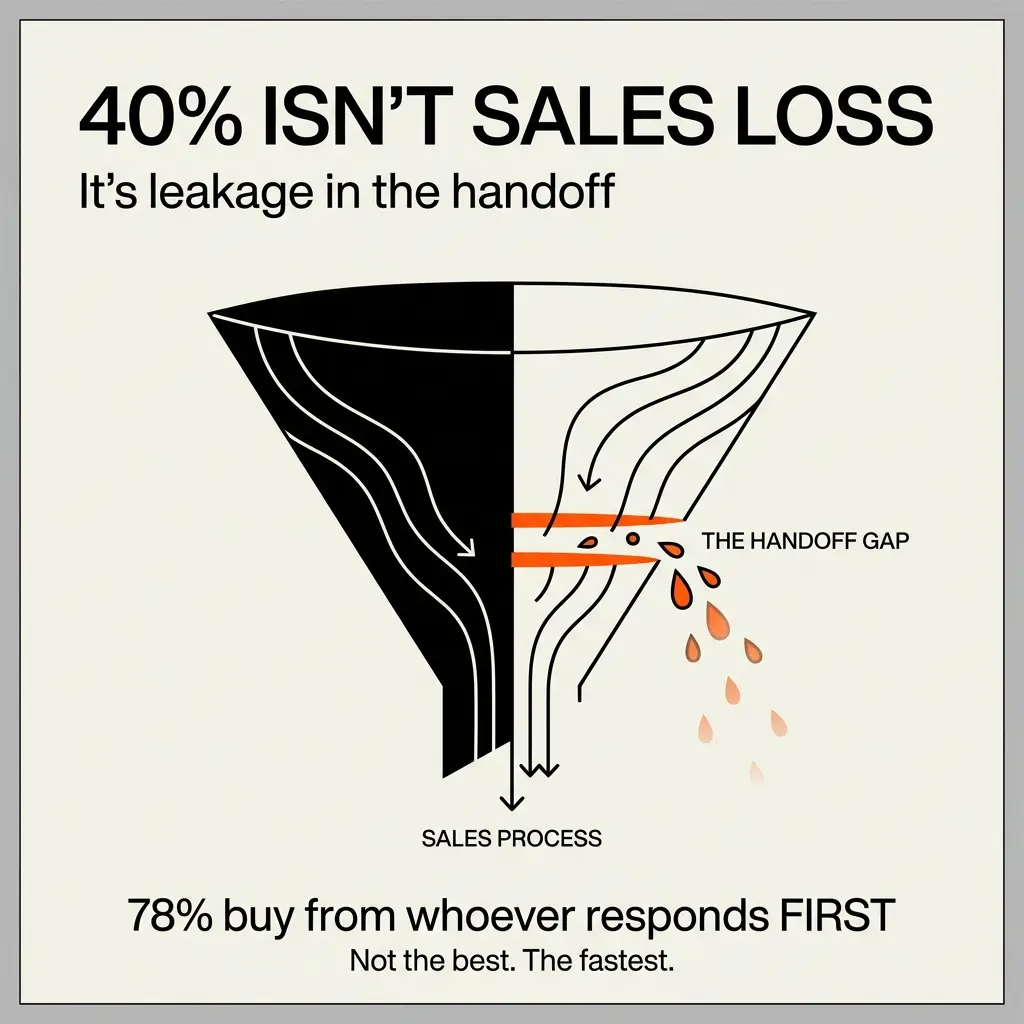
After working with over 70 agencies and building marketing systems for founders running $3-5M companies, I've seen a pattern that most leadership teams miss entirely: about 40% of your sales loss isn't happening in the sales process at all.
It's happening in the handoff.
The Difference Between Sales Loss and Sales Leakage
There's a distinction here that changes how you should be allocating resources, so let me be specific about it.
A real sales loss is going head-to-head with a competitor and not winning because you didn't put on the hook what the fish wanted to eat. You presented. They presented. The prospect weighed both options and chose them. That's a competitive loss. You learn from it, adjust your positioning, refine your offer.
Sales leakage is different.
Sales leakage is when the opportunity slipped through your fingers before you ever got to compete. It slipped out of the bottom of the bucket. You never even made it to the ring.
The most common break happens in the gap between when a customer requested information and when your team actually reached out. I see this pattern constantly: a prospect sends a request on Thursday afternoon. Your team doesn't respond until Monday morning.
Somewhere between Thursday and Monday, that customer has already talked to two or three other vendors.
Now you've given yourself four times as much work to convert that customer.
That's not customer acquisition cost. That's customer leakage expense.
The Math That Should Terrify You
The data on this is brutal, and most companies have no idea how much it's costing them.
78% of customers buy from the first business to respond. Not the best business. Not the most established. The first one to answer.
Think about what that means for your Thursday-to-Monday gap. You're not losing because you were outmaneuvered by better products or pricing. You're losing by default because your internal handoff process ensures you're never first.
Here's another number that shows the scale of the problem: businesses that respond to leads within 5 minutes are 100 times more likely to make contact than those that wait 30 minutes. Yet most businesses average 42+ hours for first response.
Your competitors aren't just faster. They're operating in a completely different conversion reality.
And it gets worse. Research shows that a one-minute lead response time can improve conversion rates by 391%. That's not a marginal gain. That's the difference between a lead that converts and one that disappears entirely.
Every minute of delay in your handoff process doesn't just cost you the deal. It exponentially increases the effort required to recover it.
The Hidden Systemic Failure
Here's what concerns me most when I audit a company's sales process: the leakage isn't an anomaly. It's the norm.
Only 27% of leads get contacted at all. Read that again. 73% of your marketing investment is funding a system designed to generate leads that will never hear from sales.
That's not customer acquisition cost. That's systematic revenue abandonment.
I've seen this pattern across industries. 53% of organizations report a broken handoff process where sales follows up on less than 35% of the engaged contacts marketing passes over. Most companies are analyzing competitive loss when they're actually watching qualified leads die in the gap between marketing qualification and sales contact.
The problem isn't that your sales team is ignoring leads. The problem is that your sales team is drowning in internal process friction that keeps them from doing the one thing that generates revenue.
According to research from Pace Productivity, salespeople spend less than 20% of their time on customer-related activities. They're spending one day a week selling and four days doing everything else. Your handoff delays aren't happening because people don't care. They're happening because the system is designed to create friction.
Why Speed Became the Primary Competitive Weapon
I used to think that superior expertise and better solutions would always win. After 64 years of pattern recognition across thousands of engagements, I've come to see something uncomfortable: speed has become more valuable than quality in the initial engagement phase.
Not because quality doesn't matter. But because you never get the chance to demonstrate quality if you're not in the conversation.
35-50% of sales go to the vendor that responds first. You're not losing to superior competitors. You're losing to any competitor who answers the phone before you do.
That reframes everything about how you should be thinking about competitive positioning. The battle isn't won in the presentation. It's won in the response time.
And here's the part that makes this particularly painful: after 5 minutes, lead quality drops 80%. This isn't about contact rates alone. It's about the degradation of intent.
A lead that requested information on Thursday is a fundamentally different prospect by Monday. Their buying intent has already been redirected elsewhere. The customer leakage expense you're absorbing includes the cost of losing them and the inflated cost of trying to re-engage someone whose problem has already been solved by someone else.
The Broader Operational Reality
Sales leakage fits into a broader pattern of operational waste that most companies are tolerating without realizing it.
McKinsey estimates that 20-30% of operating expenses are wasted on inefficiency. Rework, miscommunication, repetitive tasks, fragmented systems, and misaligned processes are bleeding companies across every sector.
But sales leakage is where it's most visible and most preventable.
You can see it in real time. You can measure it. You can trace the exact moment the opportunity disappeared. And unlike many operational inefficiencies that require complex system overhauls, fixing the handoff is often a matter of redesigning workflows and accountability structures.
I've watched companies with aligned sales and marketing teams achieve 38% higher sales win rates and 36% higher customer retention rates. The flip side is equally revealing: misaligned handoffs don't just lose deals. They systematically erode the entire customer base.
When you fix the handoff, you're not optimizing a metric. You're recovering trapped revenue.
What This Means for How You Allocate Resources
If 40% of your sales loss is happening in the handoff, you need to stop treating response time as a sales metric and start treating it as a strategic infrastructure problem.
This isn't about pushing your sales team to work harder. It's about redesigning the system so that speed becomes automatic, not aspirational.
I'd recommend auditing three specific areas:
The time gap between lead capture and first contact. Measure it. If it's longer than 5 minutes, you're operating at a structural disadvantage. Every minute you add is exponentially reducing your conversion probability.
The percentage of leads that receive any contact at all. If you're below 50%, you have a systemic handoff failure. Your marketing is generating opportunities that your sales process is built to ignore.
The internal friction keeping salespeople from engaging leads immediately. If your sales team is spending less than 20% of their time on customer activities, the problem isn't effort. It's process design.
You need to identify where the handoff breaks, who owns the gap, and what structural changes will eliminate the delay.
The Real Cost of Doing Nothing
Here's what happens if you ignore this.
You keep investing in marketing to generate more leads, assuming volume will compensate for low conversion rates. But you're pouring water into a bucket with a hole in the bottom. The more you spend, the more you lose.
You keep training your sales team on objection handling and closing techniques, assuming better skills will improve win rates. But your team never gets the chance to use those skills because prospects have already moved on by the time contact happens.
You keep analyzing competitive losses, assuming better positioning or features will win deals. But you're not losing to better competitors. You're losing to faster ones.
Customer leakage expense compounds over time. Every lost opportunity is a customer who'll now require exponentially more effort to convert. Every delayed response trains your market to expect slow service. Every handoff failure reinforces the internal dysfunction that caused it.
The companies that fix this don't just recover the 40%. They change their competitive position entirely. They become the first responder. They win by default. And they stop wasting resources trying to recover opportunities that should never have been lost in the first place.
What I'd Do Next
If I were running a $3-5M company and discovered that 40% of my sales loss was happening in the handoff, I'd make this the top operational priority.
Not next quarter. Not after the current campaign wraps. Now.
I'd map every step of the lead handoff process from capture to first contact. I'd identify every delay, every approval bottleneck, every system integration failure. I'd measure the time gap and calculate exactly how much revenue it's costing.
Then I'd redesign the system to close the gap entirely.
That might mean automating initial responses. It might mean restructuring team responsibilities so that lead follow-up becomes the highest priority task. It might mean investing in CRM integration so that leads flow directly to sales without manual handoffs.
Whatever it takes, the goal is the same: become the first responder, every time.
Because the 40% you're losing before the sale even starts isn't a sales problem. It's a systems problem. And systems problems have systems solutions.
You just have to be willing to see the leak for what it is. https://www.leadbuildermarketing.com/the-leakage-in-the-handoff/


Comments
Post a Comment